
'Our stable outlook currently points to the fact that the ratings are likely to remain stable for the next couple of years.'
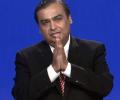
Fitch Ratings has upgraded Reliance Industries Ltd's (RIL) rating to 'BBB', one notch above India's sovereign rating, as the company benefits from cash flow generation across diversified business segments and continuation of deleveraging. In a statement, Fitch said it has upgraded RIL's long-term foreign-currency issuer default rating (IDR) to 'BBB', from 'BBB-', with a negative outlook. At the same time, the agency has affirmed RIL's long-term local-currency IDR at 'BBB+' with a stable outlook.

This is the fifth straight cut in rates by the Reserve Bank of India in as much policy reviews in 2019, and takes the total quantum of reductions to 1.35 per cent.

The best possible move would be for the government to spend the funds on activities like infrastructure development or as it deems fit, says Soumya Kanti Ghosh.

Vaccinating all citizens above the age of 18 years against COVID-19 will cost Rs 67,193 crore, of which states together will incur Rs 46,323 crore, India Ratings and Research (Ind-Ra) said on Thursday. As the second wave of COVID-19 sweeps the country with alarming speed and severity, the government has announced a liberalised and accelerated Phase 3 strategy of COVID-19 vaccination. Under this scheme, all persons above 18 years of age will be eligible to get COVID-19 vaccine doses from May 1.

While there has been a rash of growth estimate cuts, including a 0.70 percentage point reduction by the RBI last month to 6.1 per cent, the Japanese brokerage's estimate is so far the lowest.

For now, the upside appears to offset damage done to exports by weaker global demand.

Signs of a strong pickup in hiring by companies are adding to the rosier outlook for Indian households.
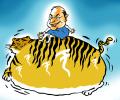
The capital infusion would help improve the financial health of banks. While some banks would get necessary regulatory capital while others would get it for fueling growth.

A rare bonhomie among three private telecom companies in raising tariffs coming on the back of a bailout package by the government may have helped the telecom sector avert a crisis but the challenges haven't ceased to exist as the industry faces a cash-guzzling task of rolling out 5G networks in the coming months. The sector that provides direct and indirect employment to millions is projected to see Rs 1.3 lakh crore to Rs 2.3 lakh crore of investments in the coming years in creating robust infrastructure and building telecom and network products that have been incentivised by the government through PLI and other initiatives. After years of cut-throat competition and the apex court ruling on payment of past statutory dues left some players in the lurch, billionaire Sunil Mittal's Bharti Airtel and struggling Vodafone Idea almost in tandem raised tariffs, taking the plunge they had long been talking about.

The widening of the CAD on a year-on-year basis was primarily on account of a higher trade deficit at $50 billion

In an interaction with Jash Kriplani, A Balasubramanian, managing director and chief executive officer, Aditya Birla Sun Life Asset Management Company, shares his optimism on what makes him believe that these cuts can help in addressing multiple issues plaguing the economy, without letting fiscal deficit pose any major risk.

With economic growth slowing to a six-year low, IMF Chief Economist Gita Gopinath says the government should undertake structural reforms such as bank clean-up and labour reforms to address the slowdown in domestic demand. She rooted for government policies focusing on managing a slowdown in domestic demand, and on boosting productivity growth and supporting employment creation in the medium term.

Till such time that a new governance framework comes into being, the progress of reforms in health, education, land, labour, electricity and agriculture could remain fraught with problems, agitations and delays, observes A K Bhattacharya.

No longer Bengal's finance minister, Amit Mitra, Mamata's principal chief advisor, will still advise and aid the 'chief minister and finance department on all matters relating to management of state finance', represent the 'state government in national and international events/meetings/committees' and examine 'important proposals/files and policy issues relating to financial matters referred to him for advice/views'.

In the first seven months of 2011-12, the Centre's fiscal deficit has crossed 74 per cent of the year's target. Inflation has been over 9 per cent for a year, despite food inflation falling considerably.

Facing the twin task of fighting the coronavirus pandemic today and building a better tomorrow, the world is experiencing a new Bretton Woods moment, IMF managing director Kristalina Georgieva said

Chand pointed out that the government is willing to discuss the three farm laws clause by clause, and farmer leaders should consider this offer.

Growth forecast has been lowered owing to tepid growth in the first half of 2017-18, the lingering effects of demonetisation, transitory challenges of GST, and some risks to agriculture stemming from a spotty monsoon.

Amid uncertainties arising out of the second wave of COVID-19, the Reserve Bank on Thursday said that a durable revival of private consumption and investment would be critical for sustaining economic growth post-pandemic. Observing that 2020-21 has left a scar on the economy, RBI in its annual report said, "in the midst of the second wave as 2021-22 commences, pervasive despair is being lifted by cautious optimism built up by vaccination drives." The second wave of the pandemic has prompted revision of growth projections for the current fiscal and the consensus appears to be gravitating towards RBI's forecast of 10.5 per cent, the report added.
The BJP still does not have a majority in Upper House of Parliament, the Rajya Sabha, and this will pose hurdles to the party's legislative reform agenda


'Money that came into mutual funds near the previous peaks -- the second half of 2017 and 2018 -- has in most cases experienced unflattering returns.' 'A large proportion of redemptions could be such inflows exiting when the market recovered sharply from July 2020 onwards.'

The resurgence of COVID-19 has dented but not debilitated economic activities in the first half of Q1 of the current fiscal even though caseload of infections is much higher than before, according to an RBI article. The ferocity of the second COVID-19 wave has overwhelmed India and the world, the article said, adding that war efforts have been mounted to stop the surge in its tracks. "The impact of the second wave on the real economy seems to be limited so far in comparison with the first wave. Evidently, the localised nature of lockdowns, better adaptation of people to work from home protocols, online delivery models, e-commerce and digital payments are at work," the article on the state of economy authored by RBI Deputy Governor M D Patra and other officials said.
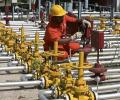
The government on Thursday hiked by 62 per cent the price of natural gas that is used to produce electricity, make fertilisers and turned into CNG to use as fuel in automobiles and cooking gas for household kitchens. This is the first increase in rates since April 2019 and comes on back of firming benchmark international prices but does not reflect the spurt in spot or current price of liquefied natural gas (LNG) witnessed during the last couple of weeks. The oil ministry's Petroleum Planning and Analysis Cell (PPAC) said the rates paid for gas produced from fields given to state-owned Oil and Natural Gas Corporation (ONGC) and Oil India Ltd (OIL) will be $2.90 per million British thermal unit for the six-month period beginning April 1.

In 2009, FinMin proposed to move regulators' reserves into public account. These accounts were finally opened in 2013-14. However, no funds have been deposited in it so far.

Upside risks to inflation persist from higher growth and expansive govt spending.

Finance Minister Nirmala Sitharaman on Tuesday said monetisation of Central Public Sector Enterprises (CPSE) assets is based on the principle of value creation for the government and investors and would bring about a paradigm shift in infrastructure augmentation and maintenance. Chairing the National Workshop with the states/UTs on Asset Monetisation organised by Niti Aayog, the minister sought the collaboration of states for the holistic development of infrastructure. She said India can become a $5 trillion economy, while striking the right balance between fiscal imperatives and socio-economic welfare, through active collaboration between the public and private sector.
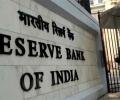
Headed by Urjit Patel, MPC for the fourth straight time kept the repo rate unchanged, at which it lends to the banks, at 6.25 per cent. The reverse repo, at which RBI borrows, will be 6 per cent.

Over 3.7 lakh companies have not filed annual returns and balance sheets, which is mandatory under the Companies Act, for the fiscal year 2008-09, Parliament was informed on Thursday.
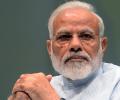
'The Modi regime is not willing to use its huge political capital for taking any economic policy measure that it fears might undermine that political strength, says A K Bhattacharya.

Salt-to-software conglomerate Tata group was among "multiple" entities who on Monday put in preliminary bids for buying the government's stake in loss-making carrier Air India.

The root of the problem, according to industry officials, is the sudden stoppage of lines of credit to tea plantation companies.

Amongst the top 10 sectors, telecom received the maximum FDI of $2.47 billion

RBI expects the growth in the next fiscal to strengthen gradually, notwithstanding the significant headwinds.
There appears to be a growing perception among the political class that faster growth will not create jobs fast enough and, therefore, welfare spending needs to be drastically increased, says T T Ram Mohan.

ICICI Bank was the top laggard in the Sensex pack, cracking over 5 per cent, followed by Kotak Bank, HUL, HDFC, IndusInd Bank, HDFC Bank and Nestle India. On the other hand, Hero MotoCorp, Bajaj Auto, Maruti, TCS and HCL Tech were among the gainers.

'The recovery process for the Indian economy would be gradual'.

'Rather than cutting and pasting from advanced economies, we should use basic economic principles to think about what is right for India at the stage of development at which we are,' says Chief Economic Advisor Krishnamurthy Subramanian.
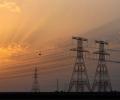
The power ministry is planning to start a second version of UDAY, aimed only at reducing the losses of discoms and improving the quality of power supply.
